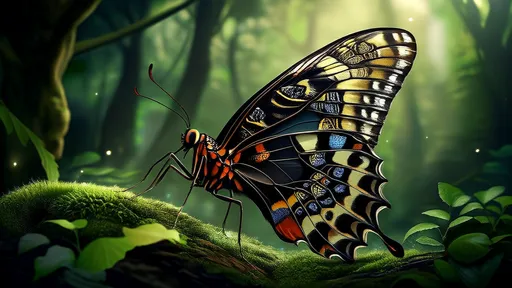
In the dense undergrowth of Southeast Asian forests, a seemingly dead leaf suddenly takes flight—only to vanish again moments later when it alights on a branch. This is no ordinary insect, but Kallima inachus, the legendary orange oakleaf butterfly, whose mastery of 3D camouflage has fascinated scientists and artists alike for centuries. Unlike flat-patterned camouflage seen in most species, the dead-leaf butterfly employs an extraordinary multisensory deception, combining optical illusion, texture mimicry, and behavioral acting to become virtually invisible.
The butterfly’s wings are a biological masterpiece. When closed, they replicate a decaying leaf down to the most minute details: irregular patches of "fungal growth" in black spots, subtle gradations of brown and ochre mimicking decomposition, and even simulated leaf veins raised in textured ridges. The forewings extend into a sharp point resembling a leaf’s petiole, while the hindwings feature a short "tail" that mimics a broken stem—an evolutionary touch that completes the illusion. Under magnification, the wing scales appear cracked and uneven like dried leaf tissue, a far cry from the iridescent blues and oranges flashed during flight.
What elevates this mimicry beyond 2D deception is the butterfly’s behavioral genius. It doesn’t merely rest on leaves; it curates its perch with theatrical precision. Observations reveal that Kallima inachus actively chooses backgrounds matching its wing pattern, often landing at angles where shadows fall naturally across its "midrib." In wind, it sways rhythmically like a dangling leaf. Some specimens even play dead upon contact, dropping to the forest floor and lying motionless with wings tightly closed—a behavior that convinces even ants to ignore them.
The evolutionary arms race behind this camouflage involves predator perception systems. Birds like the drongo, which hunt visually, have color vision extending into ultraviolet wavelengths. Remarkably, the oakleaf’s wings reflect UV light in patterns matching real leaves, foiling this avian advantage. Meanwhile, the butterfly’s erratic flight—alternating rapid flaps with dramatic glides—makes it resemble a leaf torn by wind when fleeing, further blurring the line between prey and debris.
Modern technology has only deepened appreciation for this natural wonder. 3D modeling studies at Kyoto University revealed how the wing’s microscopic structures scatter light to replicate leaf surface reflectance. Robotics engineers now study its landing algorithms for applications in adaptive camouflage drones. Meanwhile, materials scientists mimic its nanostructures to develop self-adaptive surfaces that change texture and color.
Yet the oakleaf’s greatest lesson might be philosophical. In an era where human technology pursues invisibility through digital screens and metamaterials, this butterfly achieved perfection through embracing imperfection—its camouflage works because it mimics nature’s flaws: asymmetrical spots, uneven edges, and "decaying" patches. As conservationists note, such miracles evolve only in pristine ecosystems where predator pressure remains unforgiving—a reminder that nature’s most brilliant art thrives only where wilderness still rules.
By /Jun 10, 2025
By /Jun 10, 2025
By /Jun 10, 2025
By /Jun 10, 2025

By /Jun 10, 2025

By /Jun 10, 2025

By /Jun 10, 2025

By /Jun 10, 2025
By /Jun 10, 2025
By /Jun 10, 2025
By /Jun 10, 2025
By /Jun 10, 2025

By /Jun 10, 2025

By /Jun 10, 2025
By /Jun 10, 2025