Nature's Master of Sonic Vision: How Bats Revolutionized Ultrasound Technology
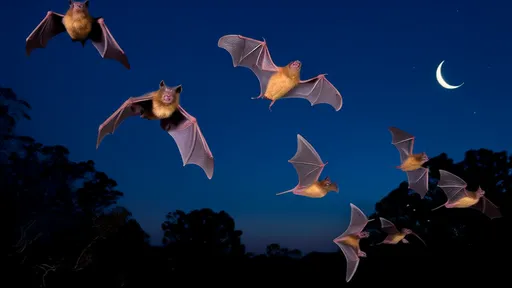
The night sky belongs to the bats. While humans fumble in darkness, these winged mammals navigate with eerie precision, hunting insects and avoiding obstacles with ease. Their secret? A biological sonar system so sophisticated it puts human-engineered radar to shame. For decades, scientists have studied bat echolocation, unraveling its mysteries to inspire breakthroughs in medical imaging, military surveillance, and autonomous vehicle navigation.
Bats emit ultrasonic waves—sound frequencies beyond human hearing—that bounce off objects in their environment. By analyzing the returning echoes, they construct detailed mental maps of their surroundings. This natural sonar operates at frequencies typically between 20-200 kHz, far above the human hearing range of 20 Hz to 20 kHz. The precision is astonishing: some species can detect objects as thin as a human hair and distinguish between different types of insects mid-flight.
Evolution's Perfect Sonar System
Over 50 million years of evolution have refined bat echolocation into an extraordinarily adaptable tool. Different species have developed specialized call structures suited to their environments and prey. Horseshoe bats, for instance, emit constant-frequency calls ideal for detecting fluttering insect wings in cluttered forests. Meanwhile, bulldog bats hunting over water use frequency-modulated sweeps that provide precise distance measurements against flat surfaces.
The sophistication extends to signal processing. A bat's brain performs real-time acoustic computations that would challenge supercomputers. They compensate for the Doppler effect—adjusting their perception when moving toward or away from objects—and can separate overlapping echoes from multiple sources. This biological signal processing happens in milliseconds, enabling split-second navigation decisions at flight speeds exceeding 30 mph.
From Cave Walls to Hospital Walls
Medical ultrasound technology owes its existence to bat biology. Early researchers studying echolocation recognized that high-frequency sound waves could penetrate human tissue and reflect off internal structures. Modern ultrasound machines operate on the same fundamental principle as bat sonar, emitting pulses between 2-18 MHz and interpreting the returning echoes to create images of organs, fetuses, and blood flow.
Recent advances push this biomimicry further. Researchers at the University of Leeds developed an ultrasound "bat helmet" that creates 3D images by mimicking the head movements and ear positioning bats use to localize sounds. This technology could revolutionize surgical navigation, allowing surgeons to "see" through tissue during operations without harmful radiation.
Military Applications Take Flight
Defense agencies worldwide study bat echolocation for next-generation surveillance systems. DARPA's "Sonar for the Soldier" program aims to create portable echolocation devices that allow special forces to navigate in complete darkness. These systems combine ultrasonic emitters with advanced algorithms that mimic bat neural processing, potentially providing 360-degree awareness without visible light.
Perhaps most intriguing are biohybrid systems that integrate living bat neurons with electronics. Experiments at Johns Hopkins have shown that bat brain tissue cultured on microchips can perform echo processing tasks with unmatched efficiency. While still in early stages, this research points toward a future where biological and artificial sonar systems merge.
Autonomous Vehicles Listen Up
The self-driving car industry faces a critical challenge: current LiDAR and camera systems struggle in rain, fog, or dust. Engineers now look to bats for solutions. Tesla's AI team recently published research on "dynamic echolocation grids" that adjust ultrasonic pulse patterns in real-time, much like bats alter their calls when entering dense vegetation.
BMW has taken this further, developing a bumper-mounted ultrasonic array that mimics the nose leaves and ear shapes of particular bat species. These biological adaptations naturally focus sound waves, and their synthetic counterparts show 40% better resolution than conventional automotive sonar. As one engineer remarked, "After 80 years of automotive radar development, nature still teaches us new tricks."
Conservation Meets Innovation
Ironically, as bat-inspired technologies proliferate, many echolocating species face extinction threats from habitat loss and white-nose syndrome. Conservationists now use ultrasound monitoring devices—themselves based on bat biology—to track populations. These portable recorders identify species by their distinctive call signatures, providing crucial data for protection efforts.
Researchers emphasize that we've only scratched the surface of bat sonar's potential. The National Science Foundation recently funded a five-year study of Amazonian bats that use echolocation to navigate through dense rainforest canopies—an environment that defeats most human-made sensors. Their findings could transform how robots operate in complex natural environments.
As we unlock more secrets of bat echolocation, one truth becomes clear: these nocturnal flyers represent millions of years of refined acoustic engineering. From operating rooms to battlefields to the family sedan, their biological sonar continues to inspire technological revolutions. The next time you see a bat darting through twilight skies, remember—you're witnessing nature's original ultrasound genius at work.
By /Jun 10, 2025

By /Jun 10, 2025
By /Jun 10, 2025

By /Jun 10, 2025

By /Jun 10, 2025

By /Jun 10, 2025

By /Jun 10, 2025

By /Jun 10, 2025
By /Jun 10, 2025
By /Jun 10, 2025
By /Jun 10, 2025
By /Jun 10, 2025

By /Jun 10, 2025

By /Jun 10, 2025
By /Jun 10, 2025