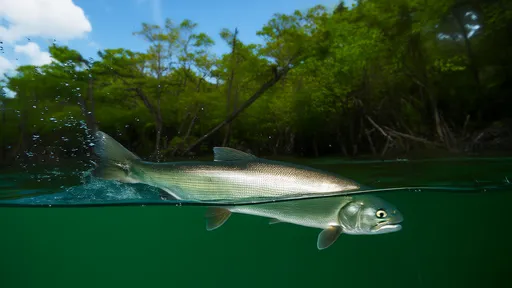
The archerfish, a small but remarkable creature found in the mangrove swamps and estuaries of Southeast Asia and Australia, has long fascinated scientists with its extraordinary hunting technique. Unlike most fish that rely on speed or stealth to catch prey, the archerfish has evolved a unique method: it shoots down insects and other small creatures with precise jets of water. This behavior, which seems almost too sophisticated for a fish, has made the archerfish a subject of intense study among physicists and biologists alike.
The Physics of a Perfect Shot
What makes the archerfish’s hunting strategy so remarkable is the precision and adaptability of its water jets. The fish doesn’t just spit water randomly; it calculates the trajectory needed to hit its target, accounting for factors like distance, gravity, and even the refraction of light at the water-air interface. When an insect is perched on a leaf or branch above the water, the archerfish positions itself carefully, adjusts the angle of its mouth, and releases a jet of water with enough force to knock the prey into the water, where it can be easily consumed.
Researchers have discovered that the archerfish’s ability to compensate for light refraction—a phenomenon that makes objects appear higher than they actually are when viewed from underwater—is particularly impressive. The fish doesn’t aim directly at the prey’s apparent position but instead corrects for this optical illusion, demonstrating an innate understanding of physics that rivals some of the most advanced human-engineered targeting systems.
The Mechanics Behind the Water Jet
The archerfish’s water jet isn’t just a simple spurt of liquid. High-speed cameras have revealed that the fish forms a small groove in the roof of its mouth, which it uses to shape the water into a focused stream. By rapidly closing its gill covers, the fish builds up pressure in its mouth, forcing the water out in a high-speed jet. The speed and shape of the jet can be adjusted depending on the distance to the target, ensuring maximum accuracy.
What’s even more astonishing is that the archerfish can modulate the force of its shot. For closer targets, it uses a gentler stream, while for distant or more stubborn prey, it can produce a more powerful blast. This level of control suggests a highly developed neuromuscular system capable of fine-tuned adjustments, something rarely seen in fish.
Learning and Adaptation
Unlike many instinct-driven behaviors in animals, the archerfish’s shooting ability improves with experience. Juvenile archerfish are far less accurate than adults, often missing their targets entirely. However, through trial and error, they learn to refine their technique, adjusting their aim and force based on previous successes and failures. This capacity for learning indicates a level of cognitive sophistication that challenges traditional notions of fish intelligence.
Studies have also shown that archerfish can adapt to new challenges. When presented with unfamiliar prey or altered environmental conditions, such as changes in water depth or lighting, they quickly modify their strategy to maintain accuracy. This adaptability suggests that their hunting behavior is not purely hardwired but involves a degree of problem-solving.
Implications for Robotics and Engineering
The archerfish’s remarkable abilities have not gone unnoticed by engineers and roboticists. The precision and efficiency of its water jet have inspired research into fluid dynamics and propulsion systems. Some scientists are exploring how the principles behind the archerfish’s technique could be applied to develop more accurate water-based cleaning systems or even miniature robotic devices capable of targeted liquid delivery.
Additionally, the fish’s ability to compensate for visual distortion has implications for underwater imaging and targeting technologies. By studying how the archerfish’s brain processes visual information, researchers hope to improve algorithms used in autonomous drones and underwater cameras, enabling them to better navigate and interact with their environments.
A Natural Wonder Worth Protecting
Despite its incredible adaptations, the archerfish faces threats from habitat destruction and pollution. Mangrove forests, which serve as its primary habitat, are among the most endangered ecosystems in the world due to coastal development and climate change. Protecting these environments is not only crucial for the survival of the archerfish but also for the countless other species that depend on mangroves for shelter and sustenance.
The archerfish serves as a reminder of nature’s ingenuity. Its ability to harness physics in such an elegant way underscores the importance of preserving biodiversity, as we never know what other marvels might be lost before we even have the chance to study them. For now, this tiny marksman continues to captivate scientists and nature enthusiasts alike, proving that even the smallest creatures can hold the keys to some of life’s most fascinating mysteries.
By /Jun 10, 2025

By /Jun 10, 2025
By /Jun 10, 2025

By /Jun 10, 2025
By /Jun 10, 2025
By /Jun 10, 2025

By /Jun 10, 2025

By /Jun 10, 2025
By /Jun 10, 2025
By /Jun 10, 2025
By /Jun 10, 2025
By /Jun 10, 2025
By /Jun 10, 2025
By /Jun 10, 2025
By /Jun 10, 2025