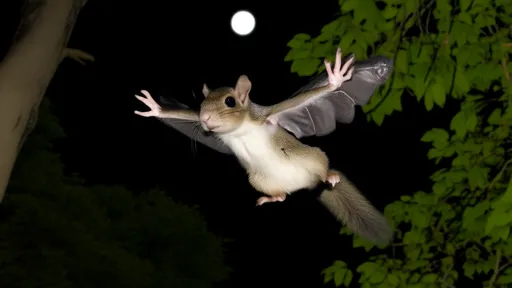
The forest canopy is a realm of hidden highways and aerial acrobats, where few mammals have mastered the art of true flight. Among these exceptional creatures, the flying squirrel – or more accurately, the gliding squirrel – reigns supreme. These nocturnal marvels have evolved a unique adaptation that transforms them into living paragliders, effortlessly navigating the treetops with a membrane called the patagium.
Unlike bats or birds, flying squirrels don't actually fly in the technical sense. Their secret lies in the stretchy skin flap that extends from wrist to ankle, creating a wing-like surface when they leap. When fully extended, this membrane allows them to glide astonishing distances – some species can cover over 150 meters in a single descent. The patagium acts as both wing and parachute, providing lift while simultaneously controlling speed and direction.
Recent studies using high-speed cameras reveal the sophisticated mechanics behind these glides. The squirrels initiate their aerial journeys with a powerful leap, often gaining extra height by pushing off tree trunks mid-air. During flight, they manipulate their patagium with wrist bones that function like miniature control rods, adjusting tension to steer around obstacles. Their flattened tail serves as both rudder and air brake, allowing for precision landings on vertical tree trunks.
The evolutionary advantages of gliding are numerous. These aerial maneuvers provide escape routes from predators, efficient pathways between feeding sites, and access to scattered food resources. In dense forests where climbing down and up adjacent trees would waste precious energy, gliding offers an elegant solution. Researchers have documented flying squirrels making dozens of glides each night as they forage across their territory.
What's particularly fascinating is how different species have adapted this basic gliding framework to their specific environments. The Japanese giant flying squirrel, for instance, has developed particularly loose skin that billows like a square parachute, enabling slower descents ideal for their mountainous habitats. Meanwhile, the sugar gliders of Australia demonstrate remarkable maneuverability, capable of sharp mid-air turns to navigate through dense eucalyptus forests.
The sensory capabilities of flying squirrels are equally impressive. Their large eyes provide excellent night vision, while long whiskers help gauge wind currents and proximity to obstacles during glides. Some species even appear to use ultrasonic frequencies for navigation, though research in this area remains ongoing. These sensory adaptations combine to create a comprehensive aerial navigation system that puts most human-engineered drones to shame.
Conservation challenges loom for these unique mammals. As forest fragmentation increases worldwide, the continuous canopy corridors essential for gliding mammals are disappearing. Some populations have adapted by gliding between isolated trees or even using power lines as glide pathways, but these makeshift solutions come with increased risks. Climate change presents additional threats, potentially altering the delicate balance of forest ecosystems these specialized creatures depend upon.
Scientific interest in flying squirrels extends beyond zoology. Their gliding mechanics inspire biomimetic designs for everything from search-and-rescue robots to innovative parachute systems. Engineers particularly study how these animals achieve such stable flight without the complex flight surfaces of birds or insects. The squirrels' ability to land gracefully on vertical surfaces after high-speed glides offers particularly valuable insights for drone technology.
Despite their aerial prowess, flying squirrels spend most of their time behaving much like their earthbound cousins. They nest in tree cavities, raise their young, and spend hours foraging for nuts, fruits, and the occasional insect. This combination of ordinary squirrel behavior with extraordinary gliding capability makes them one of nature's most fascinating examples of evolutionary specialization. As research continues, these canopy acrobats will undoubtedly reveal more secrets about the art of aerial locomotion and adaptation.
By /Jun 10, 2025
By /Jun 10, 2025
By /Jun 10, 2025
By /Jun 10, 2025
By /Jun 10, 2025

By /Jun 10, 2025

By /Jun 10, 2025

By /Jun 10, 2025
By /Jun 10, 2025
By /Jun 10, 2025
By /Jun 10, 2025
By /Jun 10, 2025
By /Jun 10, 2025
By /Jun 10, 2025

By /Jun 10, 2025